I.
I.Here follow some stray thoughts about a 1940 Warner Bros. film, directed by Anatole Litvak and starring James Cagney and Ann Sheridan, called
City for Conquest. (footnote 1) Here Cagney and Sheridan, fresh from their performances in 1938's
Angels with Dirty Faces, are paired again.
Watch the lovely trailer
On its face, the movie is a paean to the vibrancy and dynamism of American urban life typical of many big studio pictures at the time. Its story is set in 1930s New York City and opens with a dazzling montage showcasing the city's titanic scale and architectural assets. As the film starts, we're greeted by a kindly, bearded hobo -- credited as "The Old Timer" -- whose appearances as omniscient narrator bookend the film, furnishing inspiring, humanistic commentary on what takes place. His explicit refrain is that the city embraces a dizzying array of human possibilities and that it is a potent symbol of the progressive democratic hope unique to our time.
So the film's apparent message is one of strident optimism about the urban fulfillment of the promise of the American Dream. (footnote 2) The thrust of what I want to say about this movie is that there's a great deal more going on in it than that. Specifically, I think there are some crucial respects in which the film is strongly critical of its own optimistic narrative.
Cagney plays a promising amateur welterweight boxer -- Danny Kenny, AKA "Young Samson" -- who by day drives a truck at one of the city's many skyscraper work sites. Though he is a gifted fighter, shown to be easily capable of attaining the pinnacle of the sport, Cagney has no interest in professional celebrity. Indeed, we're introduced to another old timer, this one a washed-up former contender, now punchy and reduced to a custodial role in the gym, whom Cagney takes to represent the dubious wages of fame. He's content instead to crack wise alongside his Irish- (Frank McHugh) and Greco-American (future filmmaker Elia Kazan, in one of his career's two onscreen performances) coworkers, meanwhile courting his lady love and childhood sweetheart, Ann Sheridan's Peggy Nash, a gifted dancer who dreams of fame and longs to travel the world plying her trade as an "awful swell" 'hoofer.' (footnote 3)
Cagney and Sheridan's idyll is broken when a bilious, smooth-talking professional dancer played by Anthony Quinn sweeps Sheridan off her feet (literally) and tempts her with the promise of stardom. (footnote 4) To compete with this silver-tongued rapist (yes, it is strongly implied that Quinn rapes Sheridan, who presumably capture-bonds with Mr. Right while they're 'hoofing' their way across Europe and the Orient), and to finance his brother Eddie's fledgling musicianship, Cagney tours the professional circuit beating the shit out of foes and sparring partners alike (footnote 5), winning great fame and making serious jack, not that he really gives a fuck.
Cagney's brother in the film, a tortured composer struggling to realize a groundbreaking musical vision that captures and celebrates the surging dynamism of the modern city, is the film's pivotal character. The character of Eddie Kenny is played by Arthur Kennedy and clearly modeled after George Gershwin, who was born in Brooklyn, September 1898, less than a year before Cagney (who was born and raised in poverty on New York's Lower East Side). (footnote 6)
In the end Kennedy's music earns him the fame he presumably deserves and Sheridan finally abandons her errantry to reunite with Cagney. A happy future for the three main characters is implied, but I think the resolution is not as untroubled as it seems.
II.
A key feature of the movie, essential to understanding its ambivalence about the prospect of "conquest," is that Cagney's character, unlike virtually everyone else in the city, is not interested in conquest at all. He is the most conspicuously unambitious character we encounter. (footnote 7)
Even his desired relationship with Sheridan is not one of conquest. During the film's narrated opening sequence, we are shown that Cagney first won her love as a child, battling another boy in the street to defend her honor after the boy treats her roughly. Interestingly, kids and grown ups alike encircle the battling youths to cheer a young Young Samson on as he heroically decks the offending ruffian. The whole sequence has the aspect of a mythic ritual far removed from the cynical adult realities we later encounter. So Cagney's and Sheridan's bond is a fait accompli in his mind, established in the innocence of childhood. One of his refrains throughout the film -- up to and including its final line -- is that she is and always will be "his girl, no matter what."
Indeed, in the film Cagney only enters the world of professional fighting with great reluctance and from a desire to help those he loves. First, he wants to support his brother's efforts to realize his artistic vision in the only way he can -- financially. Second, he only takes up pro fighting after Sheridan makes plain her overriding desire for fame and fortune, and expresses her wish not only that Cagney "be somebody," but that he should want this, that he do it "for himself." Ever the devoted beau, "Young Samson" appeases his Delilah, pledging to try to want to succeed for himself -- for her. Really, there is no clear sense in which Sheridan is good for Cagney. Her starry-eyed determination to win acclaim as a dancer is the chief source of his anguish as her ambitious wanderlust waxes and wanes over the course of the film.
But Cagney's greatest sorrow comes during the film's final fight sequence. In the end, Cagney is literally blinded by the searing lights of the Big Time: his "lamps" are put out when he is fouled by a crooked, mobbed-up boxing opponent who stops at nothing to succeed, including lacing his gloves with an illegal granular substance that erodes our hero's eyeballs with each successive blow, costing him the fight and ultimately blinding him for life. The opponent is yet another character whose ruthless ambition is starkly opposed to Cagney's.
Interestingly, Cagney's brother in the film foresees Sheridan's abandonment at an early stage, offering a warning that casts the woman's motives and character in terms which anticipate the price his brother ultimately pays for reluctantly pursuing the corrupting ambition so alien to his nature:
“Call it applause, call it ambition, call it whatever you like. But it’d take a lot more than a man to come between you two. You see, Danny, when she rubs her eyes open in the morning, she sees her name up in bright lights: 'Peggy Nash, Dancer!' And all day long she keeps moving those lights around to different theaters and different cities. At night she goes to sleep with the music of applause in her ears. And Danny, she can’t see you and she can’t hear you because she’s blinded by those lights and deafened by that applause.”
Ironically, it is Cagney himself who is destined to be blinded by the race to the top. There is no indication that Sheridan suffers any lasting damage from her brush with celebrity, and Kennedy's creative genius is ultimately vindicated in the film's climactic scene where his symphony is embraced by an adoring public at Carnegie Hall. Cagney's ambition as a professional fighter is one into which he allows himself to be bullied by everyone in his life, particularly the two he loves most and who are the most well-meaning.
III.
Cagney's blindness is one of the movie's richest symbols. What are we to make of it?
From one point of view it could be taken as his comeuppance for pursuing an alienated ambition. For though he is his brother's avowed muse, he really has none of his own. Sheridan is his heart's desire, not one who inspires him to professionally excel; where his fighting career is concerned, she pressures rather than inspires. As for Kennedy, he is less Cagney's muse than the object of his benevolence. Cagney fights for his brother's sake, not his own, from a sincere belief in the importance and value of Kennedy's art. Once Cagney makes a career out of competitive fighting, he never authentically inhabits the role or wholeheartedly embraces his success. (footnote 8)
A salient scene during this part of the film is one in which Cagney's path and Sheridan's cross by coincidence. Cagney strays from his entourage to wander alone through the streets, and when he notices a marquee announcing Sheridan's presence, he pays an unlucky visit to her dressing room from a desire to be reunited.
Another features a montage of Young Samson's professional victories. The ringside footage is interrupted by an appearance of our all-knowing narrator, 'The Old Timer,' who reminds a spectator that Young Samson is sure to win, that "he's got to win...because he doesn't care whether he wins or not."
So Cagney's blindness can be seen as due punishment. But I don't see much merit in this line. It's hard to see how we can be expected to believe that Cagney really deserves his humiliating fate.
Rather, his blindness seems to me a kind of surrogate injury incurred on behalf of the constellation of would-be stars surrounding his character on all sides. He is martyred for their ambitions, rendering an almost Christlike, vicarious payment for his brother's public recognition and his lover's brush with celebrity.
The support his fighting provides for his brother's artistic labors is direct in a way that his halfhearted pursuit of stardom for Sheridan's sake is not. Nevertheless, Cagney bleeds for those he loves because of the depth and sincerity of his devotion, and he pays dearly for his selflessness. Where Sheridan is concerned, the devotion is largely unrequited, and where Kennedy is concerned, it is gratefully acknowledged but repaid only in words after the uptown debut of his symphony (more on this below).
Cagney's blindness thus represents the human cost of the 'conquest' which his brother's music embodies and supposedly celebrates. It is the sort of conquest made possible by the modern city and all it represents, one of which only those who are either gifted and supported from beneath (like Cagney's brother) or ruthlessly ambitious (like Cagney's cheating opponent or his chief romantic rival, Anthony Quinn's character) seem authentically capable. If this is right, one is left to wonder about the ultimate meaning and value of the sort of ambition examined in the film and of the 'city of conquest' whose chief distinction it is.
In this way, the figure of blindness exerts a powerful undercurrent in the film, complicating its 'message' by undercutting the apparent import of the triumphal opening montage.
Additionally, the blindness is an apt symbol of Cagney's inability to fathom the genius which spawned his brother's music. (footnote 9) He is not a silent partner but a blind one who cannot really even bear witness to the grandeur of the city represented by the music (and) which his own efforts and hardships help make possible. Crucially, his inability to bear witness is underscored by his humble refusal to attend his brother's successful debut at the end of the film.
For reasons already mentioned, I think the story is infused with a nascent form of class-consciousness. Any deep suspicions about capitalism, celebrity and so on which can be found in the film could well be unintended, as the novel which inspired the film was not especially politicized and Warner's would probably balk at the idea that one of their star vehicles symbolically undermines its own commercial status. However, City for Conquest was written by screenwriter John Wexley, who also wrote Angels with Dirty Faces and Confessions of a Nazi Spy (the first Hollywood film to directly identify the Nazi threat), among other films. And Wexley was a Communist Party member later blacklisted by HUAC. But it really makes no difference. Derrida tells me that The Author is D-E-A-D, so fuck it! (footnote 10)
The idea goes something like this: the humble, workaday labors of the Everyman have a kind of grandeur and nobility insofar as they make possible the more visible manifestations of the city's greatness -- its soaring skyline which we survey in the film's opening montage (footnote 11), its artistic celebration in great works of music, and so on. Moreover, the mechanisms responsible for this disparity impose costs on the 'lowly noble,' costs which are not only severe, to the point of imposing permanent disfigurement, but are as invisible as the lowly themselves.
Cagney's physical absence from the triumphant revelation of his brother's music underscores the invisibility of the severe and irrevocable cost he incurs to make it possible. Moreover, the potentially unsettling, bodily presence of the type of person which Kennedy expressly invokes in his brother's name -- the lowly, noble Everyman -- is replaced in the Carnegie Hall scene by an abstraction, an idealized image of the type Cagney embodies, summoned by Kennedy to suit his own idealistic and rhetorical purposes. (footnote 12) For after the performance, having heard the audience's applause, Kennedy offers a speech in praise of his brother, identifying him as his muse and as the indomitable, living symbol of the city's dynamic potentiality. It's revealing that the speech takes on the aspect of a funeral oration as a spectral image of his brother in full health, beaming, his ruined sight apparently restored, occupies the screen, superimposed over the stage and audience.
Cagney's absence thus permits the cultural elites in attendance to evade a confrontation with the grisly wages of the spectacle of the city's greatness conjured by his brother. Instead they are presented with a reassuring image of the once-contender (footnote 13) standing tall, proud and at the height of his powers. They are spared the reality which the audience beholds: the crippled "pug" consigned to obscurity, absently witnessing his brother's conquest, humbly sitting by a radio at a newsstand where he finds his only remaining possibility of employment.
So Cagney's absence functions in two closely related ways. It serves to efface the bodily reality of the lowly, at least for the purposes of the 'official' record; and this effacement permits elites to substitute abstract ideals and deceptively inspiring images for the damaged body thus removed from official discourse. This dual action of effacement and replacement is made even more pathological by the fact that Cagney humbly excuses himself from the spectacle of his brother's ascension to the city's upper echelon. His habitual self-effacement drives the story throughout but is never more striking and unqualified than during the film's emotional crescendo.
IV.
Of course, there are plenty of currents in the film which pull against this interpretation.
For one thing, in the film the drabness in which the Everyman's nobility is ordinarily disguised is replaced with the colorful and kinetic performance made possible by Cagney's characteristically dynamic physicality. And it must be admitted that, even at the film's end, Cagney's will is outwardly unbroken, and his performance nowhere gives any overt indication of unresolved inner conflict, let alone any resentment directed at Kennedy or the city itself. Rather he says outright that he's proud of his brother, and his love for his life and lot in the city seems undiminished as he cheerfully interacts with newsstand patrons, appreciatively inhaling the night air.
Even his blindness appears to magically fade as his eyes widen for the first time since his injury and his gaze remains fixed on his cautiously approaching, wayward love in the film's closing sequence. As the curtain closes, Sheridan -- her form somehow clearly discernible from his point of view -- assures Cagney that she's "still his girl" and always will be. And naturally, at the film's close we're treated one last time to some lofty rhetoric courtesy of 'The Old Timer' who assures us that all is well. The sentimentality of the film's end thus reinforces the optimism of its opening sequence.
Lastly, there is a reading of the film close to mine but simpler, namely that it is chiefly a parable about the dangers of losing one's integrity through the pursuit of fame and fortune. After all, each of the three main characters achieve fame through a partial or total loss of personal integrity: Cagney's triumphs in the ring come at the expense of his reservations about fame and, due to the loss of his sight, of his capacity to fight at all; the price of Sheridan's success as a dancer is an exploitative romantic and professional relationship with Anthony Quinn (footnote 14); even Cagney's brother temporarily sells out by writing Broadway showtunes before his authentic art is vindicated at Carnegie Hall.
Nevertheless, to the extent that the figure of blindness and Cagney's instinctual aversion to 'conquest' acquire the significance in the film ascribed to them above, a pronounced ambivalence runs through it concerning what is to be made of the tragic fate doled out to Cagney. (footnote 15) However he appears to be disposed towards his eventual position in the city's distribution of fortunes, the question of its justice remains. Is there really any room for that virtue in the 'city for conquest'? (footnote 16)
This question may be overshadowed by Cagney's apparent invulnerability -- another mythic quality he seems to embody. But we ought to wonder whether we should be expected to believe Cagney's stoical insistence before the last round of his final, fateful fight that he cannot really be harmed ("he can't hurt me" he (literally) blindly assures his brother, who begs him to throw in the towel). It seems that nothing short of such invulnerability -- a humanly unattainable extreme of stoicism -- could suffice to overshadow the injustice of Cagney's lot.
Cagney's loss of sight is probably a valuable clue to approaching this last question, too. Ironically, the apparent clarity, steadfast romantic and moral conviction and ultimate martyrdom of the character do come to look like a form of personal blindness. In fact, there is an especially cruel irony in the means by which the physical injury in inflicted. In a way, Cagney's own iron will and determination -- virtues, under ordinary circumstances -- are perversely responsible for the extent of his crippling injury, as the rosin dust used by his crooked opponent is ground more deeply into his eyes the longer he stands on his feet. And of course "Young Samson" lasts all 15 rounds, baffling observers with his herculean endurance.
In short, Cagney becomes an unwitting agent in his own blindness and the invisibility to which it leads because he is so uncritically at home in the thankless, self-effacing role of servant and martyr from which it stems. In the virtual eulogy delivered by his brother at the film's end, Cagney is said to possess "a great nobility far surpassing any possible conquest," despite also being claimed to have conquered in and through his crippling defeat (another Christlike characterization).
However, there now seems reason to revise the earlier suggestion that Cagney embodies the 'lowly noble' Everyman archetype whose pains are effaced and substituted for by official discourse. We may find that we want to depart even more from the film's superficially optimistic narrative, suspecting instead that Cagney's "Young Samson" is a decidedly ignoble figure. For he is all-too-obliging of the men and women in his life who displace the costs of their own irresponsibility onto him like a pack mule, a "pug" -- too obliging, surely, to really deserve the eulogy he receives. There's really very little dignity in the lot he's left with, and this may be in large part because he exercises so little agency in the roles in which he finds his lot. (footnote 17)
NOTES
1. I know nothing about film or literary criticism, so what I intend to say will be profound and original (PROBABLY NOT!).
2. Note that the film was released in 1940, just as the United States was entering the Second World War. By this time, the Great Depression was over in the main and for most Americans -- but only just.
3. Frank McHugh was an Irish-American actor with whom Cagney developed a close personal friendship over the course of the 7 or 8 films they did together. It was a partnership that laid the foundation for the so-called "Irish Mafia," a group of longtime friends and colleagues comprising Cagney, McHugh, Ralph Bellamy, Spencer Tracy, Lynne Overman, Pat O'Brien and Frank Morgan, one about which "...so much blarney has been written," Cagney later claimed in his autobiography (Cagney by Cagney (1976), Ch. 7, p. 118). There he claims that the group, whose purpose was to "get together once a week, have dinner, and make the talk," began to coalesce in the early 1940s, around the time of the release of City for Conquest. He summarizes the group's activities thus: "Laughter and fun among some old friends, nothing more" (ibid.).
An interesting side note: in the film, Cagney plays a sharp boxing contender but can't dance a lick, whereas his sweetheart can cut a rug with the best rapists this side of the Footlight Parade (see next paragraph in the body of the post above). This is a partial approximation of the biographical reality. Cagney was known in the community in which he grew up, New York's Lower East Side, as a formidable street fighter and only his mother's refusal to stand for it prevented him from becoming a professional boxer at a young age. So that part of the characterization is apt.
But Cagney first entered show business in 1919 as a self-taught dancer and spent the next decade performing in vaudeville and Broadway musical productions alongside many of the great "hoofers" of the day, including a young George Burns and lifelong friend George Raft. Like so many of the mobbed-up 'heavies' he came to play for Warner's, as a fighter Cagney could more than hold his own, but in his autobiography, he expressly describes himself as most essentially "a song-and-dance-man."
4. Quinn was at the time Cecil B. DeMille's step-son. Lucky bastard!
5. After being given the old heave-ho by Sheridan for the umpteenth time, Cagney does once unload on an unwitting sparring partner. This parallels a funny incident that occurred on set during the filming of one of the movie's fight sequences. See the Post Script below.
6. Eddie's fully realized symphony, composed by musical director Max Steiner and revealed at the end of the film in a Carnegie Hall performance, is an obvious pastiche of Gershwin's iconic Rhapsody in Blue (1924). The nearly-stolen leitmotif is as plain as the nose on my face!
7. Cagney himself resembles the diffident "Young Samson" in this regard, as he was a reluctant film star who had little faith in the acting profession and disliked the limelight intensely.
8. Consider the significance of the fact that, unlike Sheridan and Kennedy, Cagney never performs under his own name, but is instead known to professional colleagues, rivals and audiences by his pseudonym "Young Samson." Sheridan does eventually adopt a pseudonym when her partner lands a deal that has their dance troupe touring internationally -- a development, incidentally, that causes her to desert her beau anew, this time without warning, under false pretenses and after a short-lived reunion halfway through the picture during which she promises marriage, all of which constitutes the story's most egregious betrayal. However, she initially dances and enjoys national success under her own name.
9. There is a scene during Cagney's convalescence after being blinded in which the theme of ignorance is underscored in a way that evokes the Allegory of the Cave found in Plato's Republic. Cagney is abed but wakes and is drawn by the sound of piano and singing into the adjoining parlor where some friends are partying. Taking up his point of view, the camera moves from his position on the bed to a visual representation of what little sight remains to him: the shadowy play of silhouettes on the bedroom door.
10. Derrida is too hard to read. It's usually not worth it!
11. Recall that Cagney's first and primary occupation is driving a truck at a city work site alongside his childhood friends. Cagney and and type he embodies are thus literal agents of the city's construction.
12. Kennedy invokes his brother's prosaic "nobility" during his speech, "a great nobility that far surpassed any possible conquest:" "Yes, my brother made music with his fists, so that I might make a gentler music."
13. Compare with this later, immortal scene. Is Brando's Terry Malloy really a more pitiable character than Cagney's Danny Kelly? It's interesting to note that On the Waterfront was directed by Elia Kazan, who, as earlier remarked, here plays "Googi," Cagney's wayward pal-turned-gangster in the first of his only two acting roles. Could Cagney's "Young Samson" have been on Kazan's mind when planning, casting and making On the Waterfront? This makes me want to do a series on washed-up, has-been or never-was fighters of the silver screen. Lucky you!
Incidentally, Kazan allegedly later claimed to have learned a great deal from working with Cagney. Kazan was a veteran of New York's famous Group Theatre and a co-founder of the postwar Actors Studio, both of which developed what came to be known as "The Method," an approach to acting technique indebted to the teachings of Russian actor and theatre director Constantin Stanislavski. Kazan admired Cagney's instinctive prowess as a performer which carried him to the height of his profession despite his having never had an acting (or dancing) lesson in his life. Cagney famously summed up his approach to acting in the following way: "You walk in, plant yourself squarely on both feet, look the other fella in the eye, and tell the truth."
14. It's at least strongly implied that Sheridan's relationship with Quinn's character is sexually active, whereas there's no indication in the film that she ever consummated her relationship with Cagney.
15. There is one notable exception to the omniscience of the film's narrator, 'The Old Timer.' During Cagney's final fight, The Old Timer is shown amongst the audience and is overheard to express his confidence in our hero's victory. The mouthpiece of the film's superficial optimism is thus contradicted by what actually transpires -- the undeserved crippling of the story's central character. Here the film's ambivalence manifests itself in a dramatically overt rupture in its own projected narrative arc. God is dead!
16. Key aspects of the story suggest that injustices routinely go unpunished in the 'city for conquest.' To name only two: Quinn's implied rape of Sheridan and the crooked fighter's cheating conduct responsible for Cagney's blindness.
17. However, both agency and dignity are overrated. The End!
Post Script
Here, in his own words, is what Cagney himself made of City for Conquest. Given his low estimation of the finished product, which seems to me rich and provocative for all the reasons I've gone on about, one can only wonder at what the version he ideally envisioned might have offered:
"In those days when pictures had to be cranked out on an undeviating schedule, one went everywhere for screen stories, and sometimes the original sources were good, sometimes bad. City for Conquest, which we did in 1941[sic], is an example of the former, being taken from Aben Kandel's novel of that name, a novel with some fine things in it. I went to work on that picture with something of a will for just that reason. I played a truck driver turned fighter, and so I dieted and trained myself from 180 pounds down to 145 in order to do the fights. To get in the ring and be convincing one has to be in shape or one drops down dead.
I did all my own fight scenes; the prospect of a few punches in the puss never bothered me. I was hurt once in the picture. They threw in a fair-to-middling fighter who had been a pro, and this was his first appearance in pictures. I think he figured one job was going to make him a star because when the director said, 'All right, action!' the fighter got a little excited. He threw one, hitting me right on the chin. A dandy. I swung around so the camera couldn't see me, and I laughed as I said 'Oh, you son-of-a-bitch.' I got a kick out of it because his face was absolutely stricken when he realized what he had done. Then I threw one, hitting him square on the chin, and his knees buckled. We mixed it up and finally the director said to cut and to print it.
'My God, Joey,' I said, 'did I hurt you?'
He said, 'I saw my whole family. I saw my whole family. I saw my Uncle Ben, my Aunt Minnie, I saw my Cousin Davey. I saw them all'...
...I worked like a dog on City for Conquest. There were some excellent passages in Kandel's novel, passages with genuinely poetic flavor, and all of us doing the picture realized that retaining them (as we were doing) would give City for Conquest distinction. Then I saw the final cut of the picture, and this was quite a surprise. The studio had edited out the best scenes in the picture, excellent stuff, leaving only the novel's skeleton. What remained was a trite melodrama. When I realized what they had done, I said to hell with it, and that cured me of seeing my pictures thenceforth. I even wrote a letter of apology to the author. Yet City for Conquest did well at the box office, which ought to prove something or other."
(from Cagney by Cagney (1976), pp. 95-96)
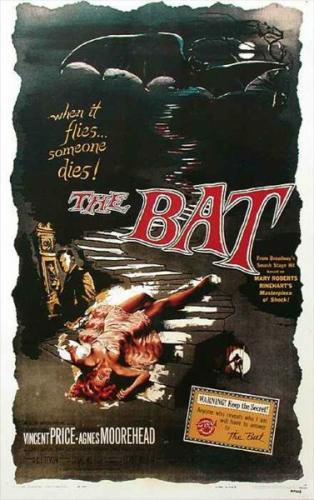 The Bat is a 1959 crime thriller directed by Crane Wilbur and starring Vincent Price and Agnes Moorehead It's the third film adaptation of a 1920 broadway production of the same name that was first adapted as a silent film in 1926 by Roland West, then again by West in 1930 as a talkie entitled The Bat Whispers. It's worth noting that Bob Kane credited the masked villain of the 1930 film as an inspiration for the comic book character of the Batman that he co-created in 1939.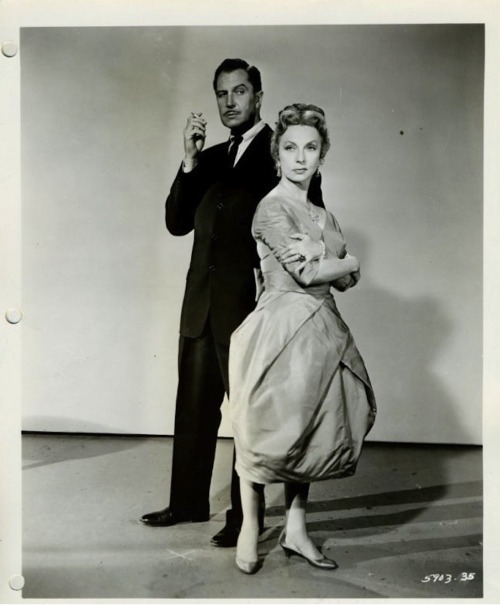



.jpg)